


Short answer
PitchBook offers company, deal, fund and valuation data for private capital markets. Private equity firms, banks and M&A teams use it. On PitGrowth, a corporate posts a need and technology companies apply to it. Radar shows which organisations want to buy what. One focuses on deal and valuation data, the other on doing business together.
What is PitchBook?
PitchBook was founded in Seattle in 2007 and has been part of Morningstar since 2016.
It offers data and research on private companies, funding rounds, funds, investors and valuations. There is no free plan, and prices are not published.
PitchBook vs PitGrowth comparison table
| PitchBook | PitGrowth | |
|---|---|---|
| Main purpose | Private capital market data: companies, deals, funds, valuations | Connecting corporates with technology suppliers |
| Who it's for | Investment funds, private equity, banks, M&A teams | Corporates, technology companies, investors, tech hubs |
| Corporate needs | None | Wishlist: the corporate posts its need and collects applications |
| Signals | Market intelligence, portfolio tracking | 5 main categories, 22 subcategories, including buying and solution search |
| Level of detail | Company, deal, fund and valuation data | Product and service level: 1.5 million solutions |
| Türkiye | Part of global coverage | Home market: products, services, value propositions and success stories of more than 17,000 Turkish companies; Europe and the UAE also covered |
| In the company profile | Funding history, investors, valuation, financials | Products, services, references, success stories, technologies used |
| Pricing model | Prices not published; annual licence per user | Plans: Free, Start, Growth, Scale, Enterprise |
| Free option | Trial on request; no free plan | Free plan, no credit card needed |
PitchBook information is from pitchbook.com, checked in November 2026.
Who is PitchBook for?
If you need to look at a company's valuation, the details of its funding rounds, fund performance or comparable deals, PitchBook was built for that work. Private equity firms, investment banks and M&A teams use it.
What does PitGrowth add?
For corporates
PitchBook shows how much money a company raised and who owns it. Finding out which company can solve your problem is still up to you. On PitGrowth you post your need as a Wishlist, and the right companies apply to you. Pit AI scores each application against your criteria and explains why.
You can also hand the search to Pit AI. Type something like "companies in Türkiye doing machine vision on production lines", and Pit AI returns the firms that do this work, with the ones that have references singled out. The Pit AI guide shows how to ask.
As of November 2026, the 27 wishlists opened by 14 organisations on PitGrowth had received more than 1,600 applications. For example, 75 technology companies applied to İnci Akü's open innovation call on 2 critical problems in battery production. See how it works in the Wishlist guide.
For technology companies
PitchBook is used mostly by investors. As a technology company, what you are after is new customers. Open Radar's Buying category and you see program calls, supplier choices and budget announcements from organisations. You can also apply to open wishlists on the Free plan.
For investors
PitchBook shows closed deals in detail. Radar catches the signs before a company raises. Proof covers new customers and success stories. Moves covers new partnerships, market expansion and program acceptance. Startups looking for investment are also listed separately in Scouter.
What signals does Radar collect?
Radar reads what companies post about themselves and turns it into signals, using our own technology. Signals fall into 5 main categories: Proof, Moves, Money, Buying and Visibility. There are 22 subcategories under them.
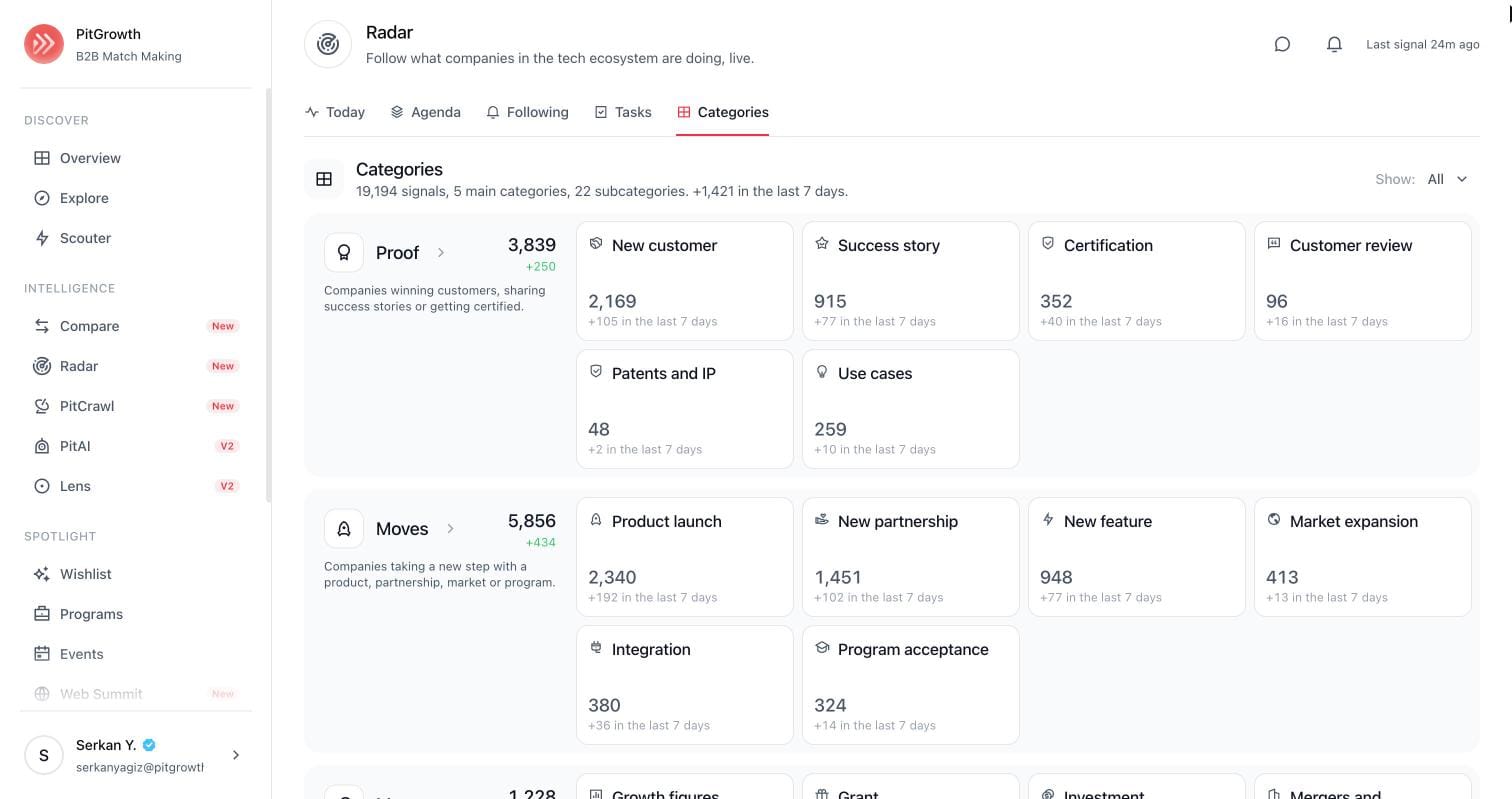
All signals are open on the Scale and Enterprise plans. The Radar guide explains what each category means.
With the Free plan you can look at Radar and open wishlists right away. Compare plans
Which one should you choose?
PitchBook for valuation, fund and deal data. PitGrowth for business between corporates and suppliers, and for the signals that come before an investment. You can also use both: check a company's funding history on PitchBook, then see its products, references and latest signals on PitGrowth. To see all the platforms side by side, read our Crunchbase alternatives comparison.
Frequently asked questions
Is PitchBook free?
No. PitchBook has no free plan and does not publish its prices. It is sold as an annual licence per user, and trials are given on request. Contact PitchBook's sales team for current information.
Does PitchBook cover Turkish companies?
PitchBook includes Turkish companies in its global coverage. On PitGrowth, Türkiye is the home market: the platform holds the products, services, value propositions and success stories of more than 17,000 Turkish companies.
Is there a free PitchBook alternative?
It depends on what you need. If you want valuation and fund data, PitGrowth does not replace PitchBook. If you want to find technology companies, follow corporate needs or track company signals, you can start on PitGrowth with the Free plan. Browse open wishlists.
Sources
pitchbook.com · Checked in November 2026.


Discussion