


The 5 Digital HR Priorities at PitStop #13
On May 12, 2026, the agenda at PitStop #13 was clear: where do the real bottlenecks in corporate HR operations sit, and which technologies answer them with something concrete? HR-focused corporate professionals from 42 enterprises, Enerjisa, Turkish Aerospace, Turkish Airlines and Yapı Kredi among them, met in the same online session. In front of them were five technologies that complete one another: PeopleBox, Aidea, RapidSOL, Waytogo and HRScale (PeopleRun).
The session ran 90 minutes. Each technology company first spent 7 minutes on its product and a real customer case from the field, followed by 3 minutes of questions. Engagement stayed high from start to finish. Performance management, training content production, employee self-service: the themes sitting at the top of the 2026 HR agenda are turning into concrete investment line items in corporate budget planning.

The 5 Layers of Digital HR: The 5 Presenting Technology Companies

PeopleBox — AI-Powered Recruitment and Candidate Assessment
Smart Recruitment: Choose the Right Candidate Without Bias

Aidea — AI-Driven Training Content Production
Agile Training Content: In Your Company's Own Voice, Within Days

RapidSOL — Employee Self-Service and Daily HR Operations
Operational Freedom: Hand the HR Workload Over to the Employee

Waytogo — Structured Mentorship and Career Management
Institutional Memory: Turn Mentorship Into a Measurable Process

HRScale — AI-Powered Performance and Career Management
Continuous Performance: From Goal Tracking to Career Planning
How Mature Is Your Organization's Digital HR? A Quick Checklist
Talking about digital HR transformation is one thing; seeing your organization's real situation is another. The five questions below are built on the five core layers that took center stage at PitStop #13. Give an honest "yes" or "no" to each one. By the end, you will see clearly which area your organization should prioritize.
Open the Checklist and Test Your Organization
1. Recruitment and Candidate Assessment
Would your different interviewers recommend the same candidate for the same role? Are your candidate assessment criteria consistent from one interviewer to the next?
✅ Yes → Your recruitment process has objectivity
❌ No → A need for standardized assessment has emerged
2. Training and Content Production
When a new training need arises (a regulatory change, a product launch, an onboarding update), in how many days can you get the content to employees?
✅ Within 1 to 2 weeks → You have an agile L&D process
❌ A month or more → Your content production speed has become a bottleneck
3. Employee Self-Service and Operational Load
For daily requests like leave, expenses, advances, shifts and asset assignment, do your employees have to message the HR team?
✅ No, the employee manages it on their own → You have solved the operational load
❌ Yes, it still goes through HR → Your HR team is stuck on routine work
4. Mentorship and Institutional Memory
When a senior employee leaves the company, does their 10 to 15 years of experience get transferred in a structured way?
✅ Yes, our mentorship program is actively running → Your institutional memory is protected
❌ No, the knowledge leaves with the person → Your talent retention risk is high
5. Performance Management
Is your performance review a form filled out once a year, or a continuously running process?
✅ Continuous flow, real-time feedback → Aligned with the 2026 performance model
❌ Annual form → Your performance management approach is an area that needs updating
What Your Result Means
- 5 yes → You are in the top tier of digital HR maturity in Türkiye. You can look at optimizing newer technologies.
- 3-4 yes → The foundation is solid, and you can win quickly in one or two layers. The areas you answered "no" to are the priority candidates for your 2026 budget.
- 1-2 yes → You are on the edge of a structural HR transformation. For a complete roadmap, the technologies presented at PitStop answer directly across different layers.
- 0 yes → You are at an early stage, but you have an advantage: if you build it right from scratch, you avoid the legacy migration pains felt in the intermediate layers.
Digital HR 2026 Trends: Why Invest Now?
The digital HR conversation in Türkiye is not new; but 2026 stands out as the year it moved from the "talking" phase to the "budgeting" phase. According to Deloitte's 2025 Global Human Capital Trends report, 73 percent of executives are experiencing a strategy gap rooted in the blurring line between people and technology. In Türkiye, that gap turns into something more concrete: 38 percent of mid-size and large companies in Europe use AI-powered pre-screening in recruitment, while in Türkiye that figure sits at around 12 percent for now. It is expected to double by the end of 2026.
The five layers brought to the table at PitStop #13 are no coincidence. These layers are fed by four core forces on the 2026 HR agenda. First, AI is no longer a "trend" but a concrete efficiency item: in a 50-candidate pool, the cost of manual pre-screening is 4 to 5 times that of an AI-powered process. In parallel, employee experience is converging onto a single mobile platform; running processes like leave, expenses, shifts and payroll piece by piece counts as a competitive disadvantage in 2026. A third major shift is on the performance side, as the annual review gives way to continuous feedback loops; according to Gartner, half of Fortune 500 companies will have fully dropped the annual review by 2026. And finally, there is talent retention pressure: a senior employee's 10 to 15 years of experience leaving the company without structured mentorship is the quietest yet most expensive loss in digital HR maturity.
When these four forces work together, what emerges is not buying software piece by piece, but building an HR technology architecture whose parts complete one another. Each of the five technology companies presented at PitStop #13 maps to one layer of that architecture: from recruitment to training, from employee operations to mentorship, to performance management. For an HR team planning its 2026 budget in Türkiye, the question is no longer "will we move to digital HR"; it is "which layer do we start with, and in what order do we proceed."
Sectors Investing in Digital HR in 2026
The sectoral breakdown of the session shows that digital HR transformation is no longer the concern of a single industry:
- 19% Banking & Finance
- 17% Industry & Manufacturing
- 10% Textile & Apparel
- 10% Food & FMCG
- 7% Retail & Services
- 7% Technology & Ecosystem
The remaining 30 percent included corporate representatives from defense, pharmaceuticals, automotive, insurance, holding groups, furniture and energy. This diversity shows that digital HR transformation is no longer on the agenda of one specific sector, but of every organization with more than 200 employees. From performance management to mentorship, from employee self-service to training content production, the agenda items are converging across a bank and a manufacturer, across retail and the defense industry.
Digital HR Maturity in Türkiye: What Do 400+ Organizations Say?
You can explore the forces behind this sectoral diversity in our article analyzing the HR priorities of 400+ corporate professionals:
 Pit Team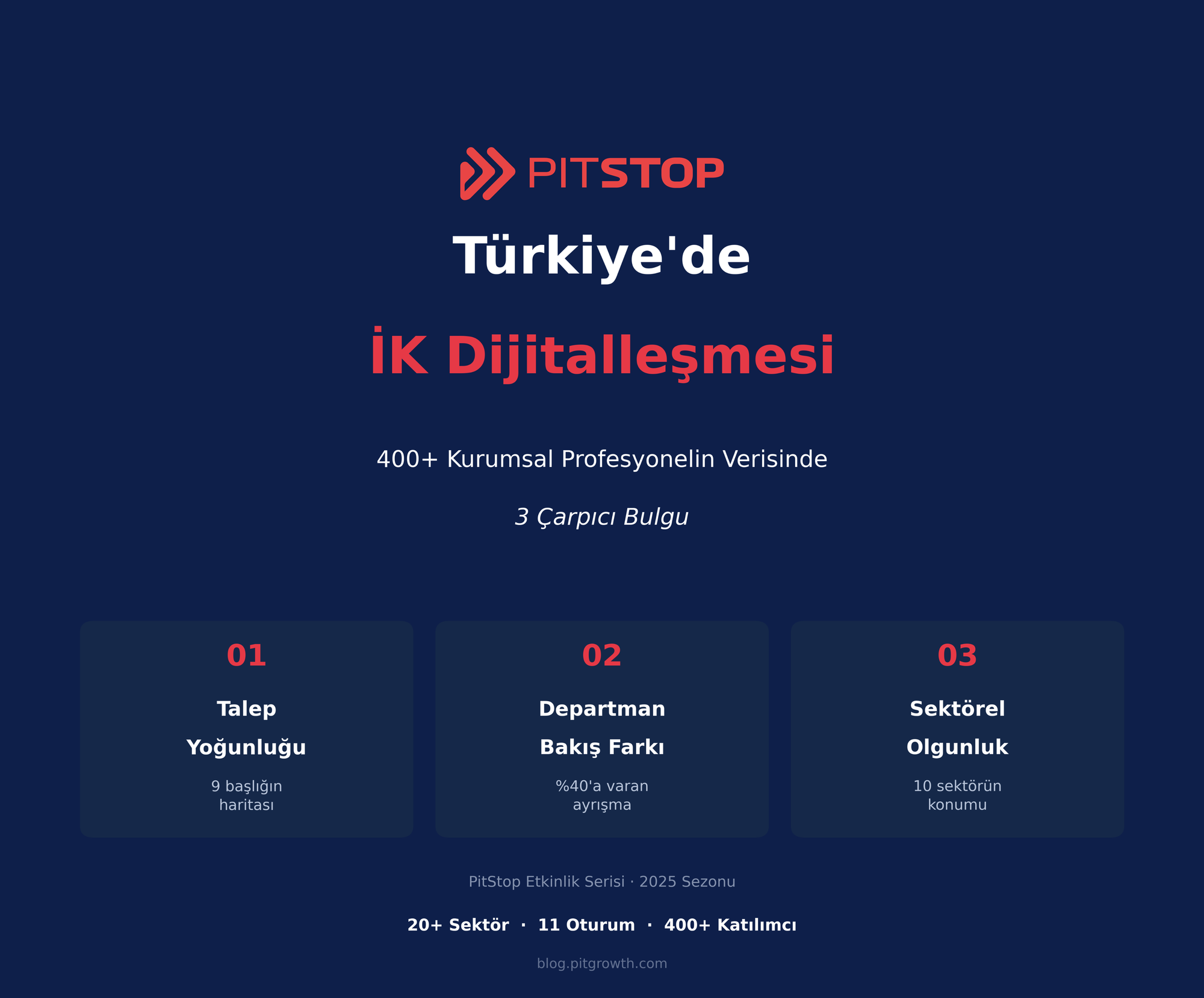
How to Choose the Right HR Technology?
If you are a corporate company looking for access to technology solutions in HR, energy, finance or other verticals, explore the outcomes of previous PitStop sessions:
 Pit Team
If you are a technology company and want to meet the right corporate customer at the right time, register to take part in our PitStop sessions:
👉 https://forms.office.com/r/FsXhmJNkFM
PitStop is a session series that brings technology companies and corporate companies together around the right theme, at the right time. For each theme, more than 60 technology companies are interviewed one on one; agenda fit, references, success stories and upcoming-period focus areas are evaluated, and the best fit for the theme is selected. The selected companies are arranged so they do not compete with one another; corporate participants are invited to the session based only on theme-related presentation titles, without knowing which technology company is behind them. This creates a neutral decision environment and lets real needs come forward.
PitStop Sessions Held This New Season
 Pit Team
 Pit Team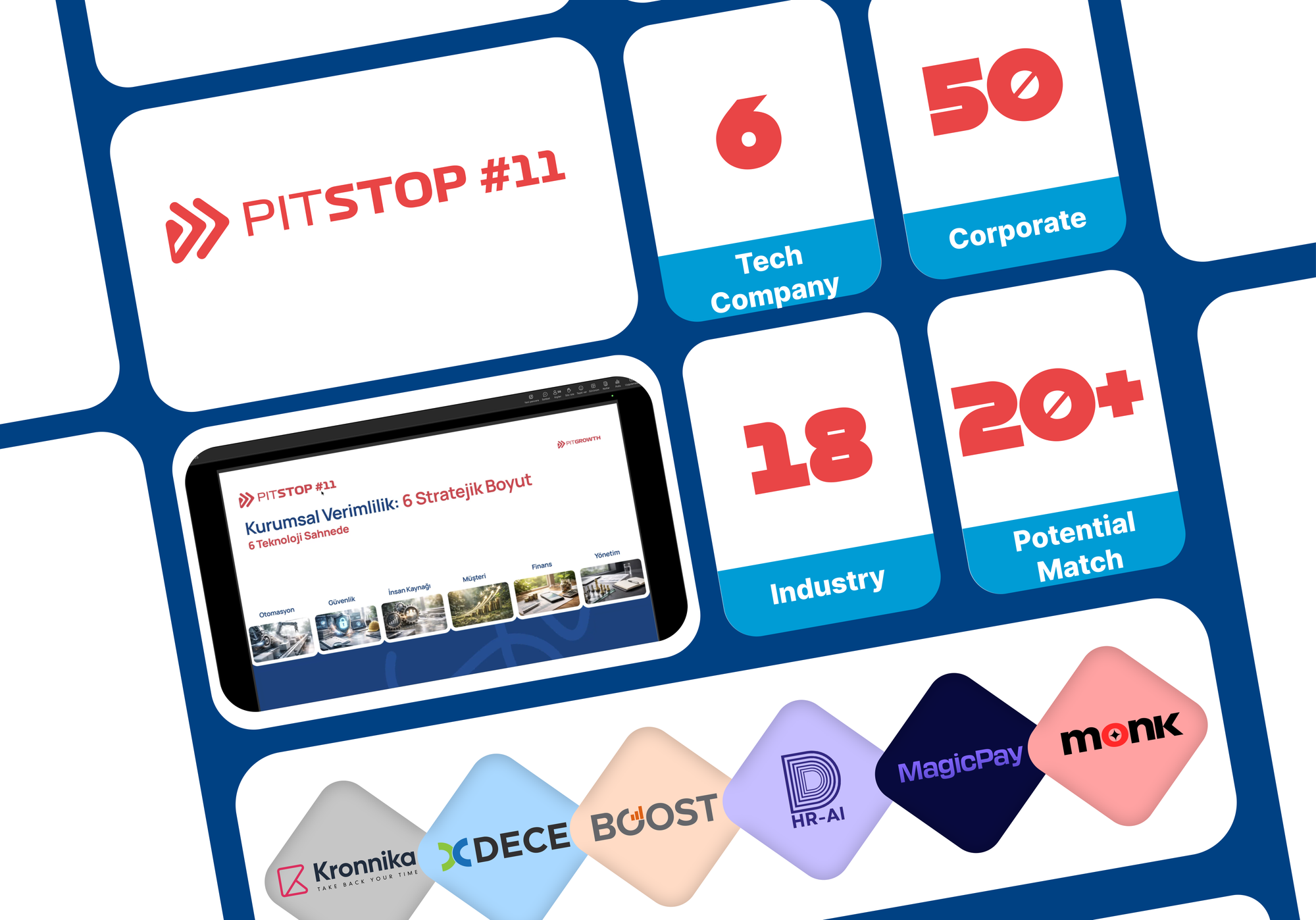
 Pit Team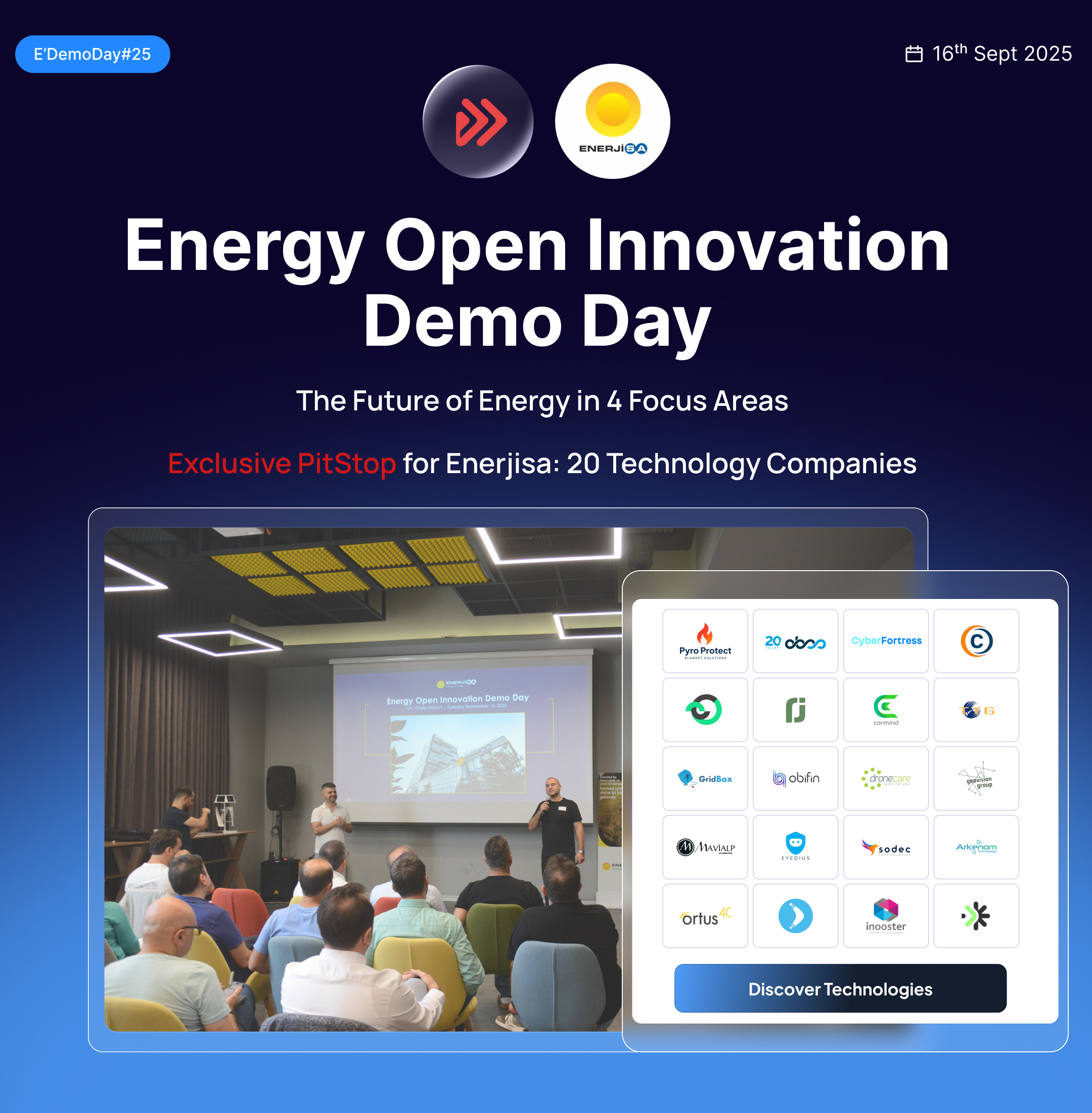


Discussion