


An HR director at a company wants an "AI-powered talent management system." The operations manager at the same company is looking for a "task tracking platform." Two offers from two vendors, two budgets, two pilots. This picture is not an exception in Türkiye. Data from 400+ corporate professionals shows the statistical evidence for it.
Over the last 11 PitStop sessions, we asked corporate professionals from different industries about their HR digitalization priorities. Even in sessions on manufacturing, energy, finance or retail, HR topics stayed on the agenda. This gave us a cross-industry view of Türkiye's HR digitalization priorities.
We mapped the data on three dimensions: which topics are in highest demand, whether HR and other departments in the same company want the same things, and where each industry stands. Read together, the charts show that in Türkiye HR digitalization is a question of architecture, not of tools.
Methodology: Where Does the Data Come From?
In the previous season of the PitStop event series we held 11 sessions. Each session covered a different corporate theme: manufacturing, customer journey, digital HR, operational efficiency, energy, finance, productivity, Industry 4.0 and others. Whatever the theme, we also asked the corporate professionals who attended about their HR-focused digital transformation priorities.
More than 400 corporate professionals shared their HR priorities with us. The data covers more than 20 industries, departments from HR to operations, and every decision-making level from specialist to C-level.
HR needs were grouped under 9 headings: recruitment and assessment, digital processes and approvals, employee engagement and performance, OKR and KPI management, wellbeing programs, talent management, occupational health and safety, task tracking, and document and archive management. Participants could select more than one.
Finding 1: The HR Needs Maturity Matrix
In the first map, we placed each heading on two axes: demand (how many organizations selected it) and the nature of the topic (strategic or operational).
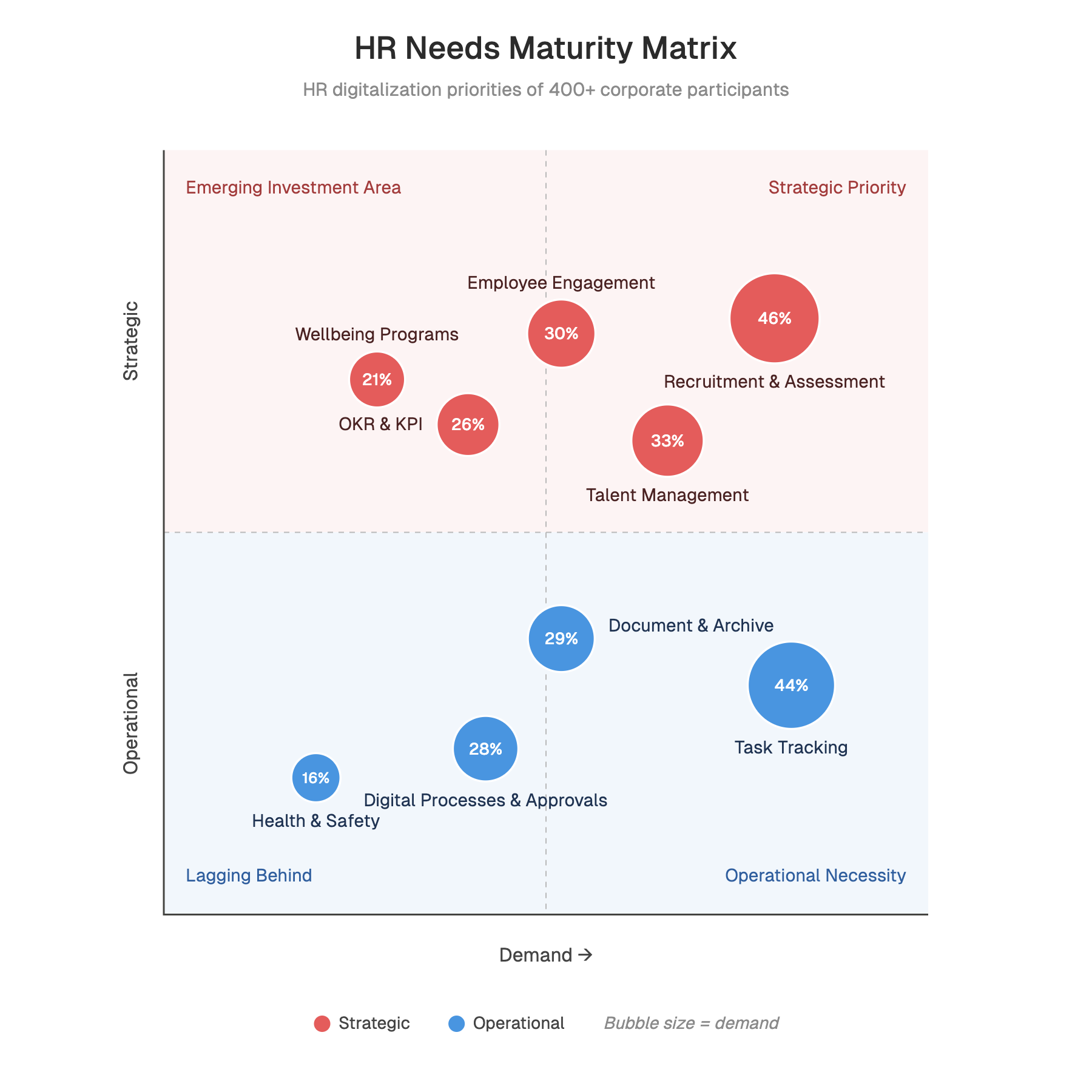
The top-right corner is the most critical zone: topics that are both in high demand and strategic. Two headings stand out here. Recruitment and Assessment is the most demanded topic in the market at 46%. Talent Management follows at 33%. Together, they show that "selecting and retaining talent" sits at the top of companies' HR agenda.
The bottom-right corner holds the operational necessities. Task Tracking leads here at 44%. This clearly shows how much companies need operational discipline. Document and archive management and digital processes and approvals are the other members of this zone.
The top-left corner holds emerging investment areas: employee engagement, OKR and KPI management, and wellbeing programs. Demand has not yet reached "must-have" level, but because these topics are strategic, they are likely to move up the agenda in 2026 and beyond.
The heading furthest behind is Occupational Health and Safety: at 16%, it carries the least weight on the market's agenda.
HR digitalization in Türkiye is moving in two directions at once. Companies want AI-powered solutions for talent on one side and tools that ease the daily operational load on the other. Wellbeing stays at the level of talk; demand has not yet turned into investment decisions.
Finding 2: Two Different HR Agendas in the Same Company
The second map is where it gets interesting. The HR department and the other departments (operations, IT, innovation, finance and so on) in the same organization expect completely different things from HR digitalization.
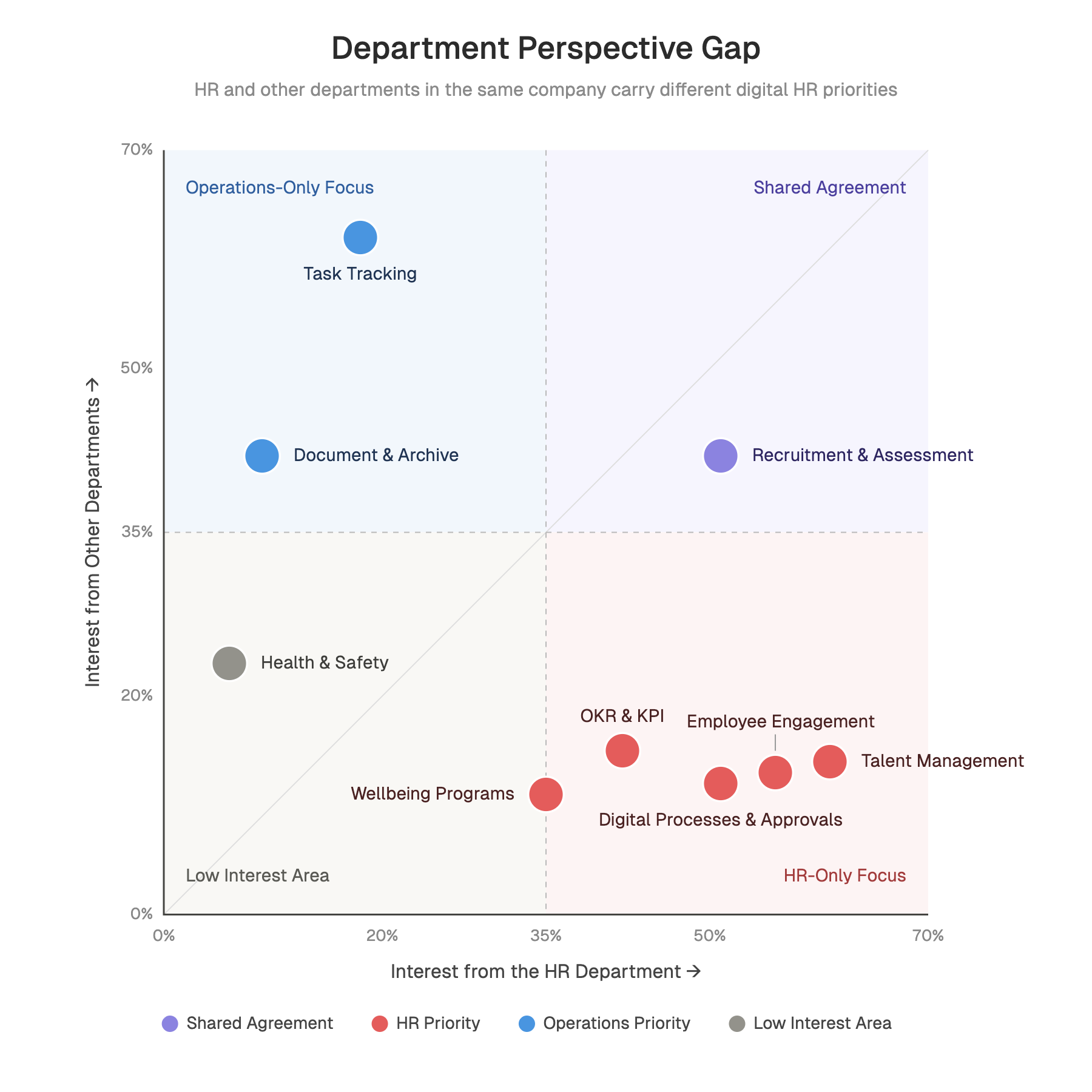
Only one heading sits in the top-right corner: Recruitment and Assessment. 51% of HR departments and 42% of other departments consider it important. Among the 9 HR headings, recruitment is the only topic both sides agree on.
On the other 8 headings, the picture splits completely.
The HR department alone focuses on: Talent Management (HR 61% vs. others 14%), Employee Engagement (56% vs. 13%), Digital Processes and Approvals (51% vs. 12%), OKR and KPI (42% vs. 15%), Wellbeing Programs (35% vs. 11%). On some headings the gap exceeds 40 points.
Operations and other departments look at a different front: Task Tracking: other departments 62%, HR 18%. Document and Archive: others 42%, HR 9%. In other words, operations is trying to digitalize on its own the topics that are not on the HR team's agenda.
Many organizations run two parallel digital HR investments. HR looks for its own tools, operations tries others, and the tools do not feed each other. The result is a fragmented technology landscape and disconnected data silos.
One interesting note on occupational health and safety: only 6% of HR departments consider it important, while other departments show four times more interest at 23%. Ironically, occupational health and safety looks like a priority for field units rather than for HR.
Finding 3: The Industry Maturity Map
In the third map, we placed the 10 industries with 15 or more participants on two axes: digital HR maturity (average number of headings selected per person) and strategic orientation (share of strategic headings in the total).
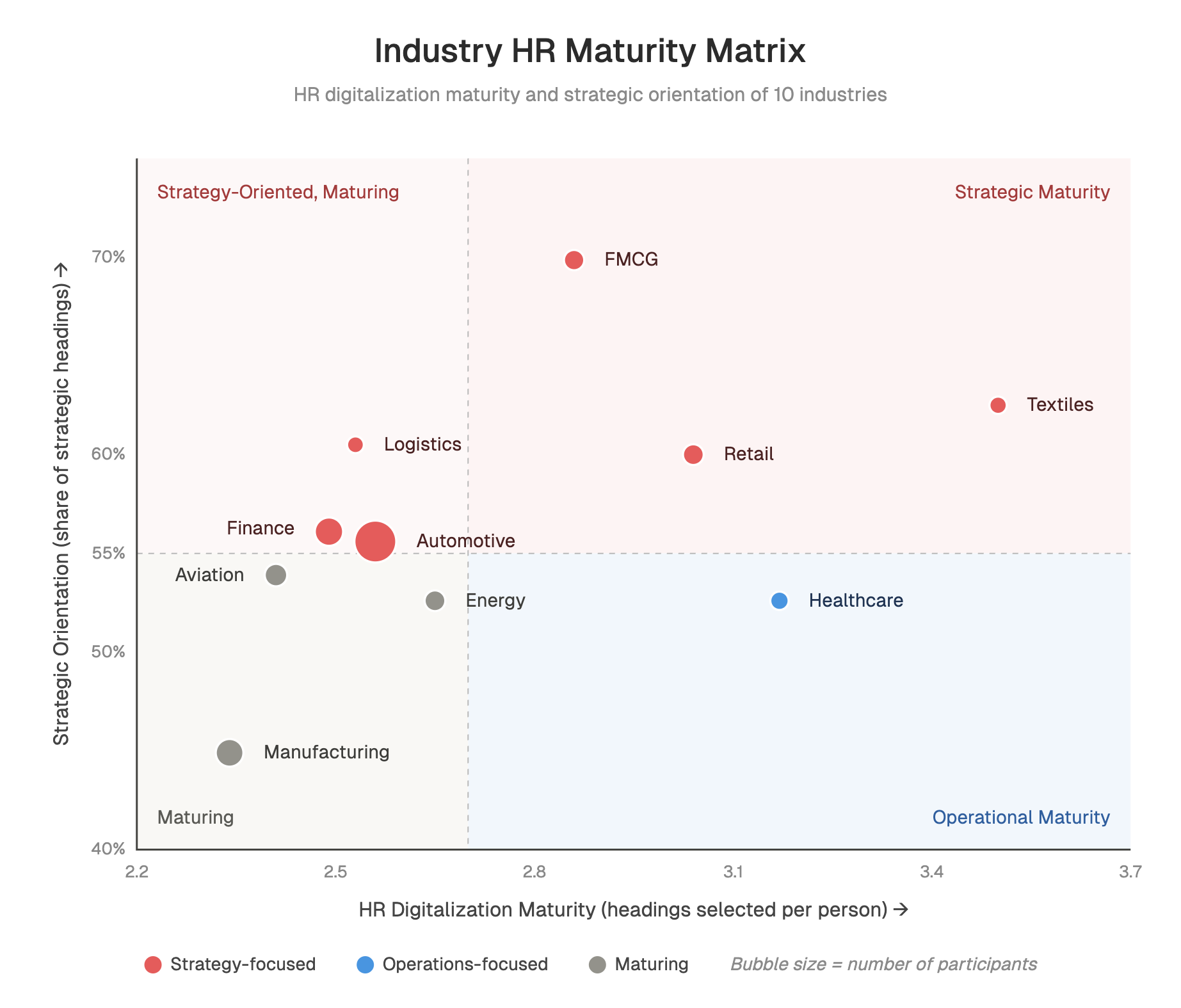
The top-right corner is the "Strategic Maturity" zone. Four industries sit here: Textiles, FMCG, Retail and Healthcare. These industries invest relatively more in digital HR and also prioritize strategic topics.
Textiles is an unexpected leader. With 3.5 headings per person and 62.5% strategic orientation, it tops the map. FMCG leads the strategic axis at 70%, which reflects the industry's international competition and war for talent.
Healthcare stands alone in the bottom-right corner. Maturity is high (3.17) but strategic orientation is low (53%). Healthcare invests in digital HR but spends its energy on operational topics such as task tracking and documentation. Shift work and high staff turnover may be the reason.
Automotive, Finance, Aviation, Energy, Manufacturing and Logistics cluster on the left. These industries are still maturing in digital HR. The position of Manufacturing and Aviation in the bottom-left corner stands out. With their operations-heavy structures, they do not yet seem to have put digital HR on their priority list.
Automotive is in a different position. Although it is the largest corporate group in our data, it has not clearly shifted toward either the strategic or the operational side. Despite its size, this lack of direction suggests that HR technology decisions in the industry have not yet matured.
Most Demanded Headings by Industry
Beyond the overall map, each industry has its own agenda. These are the two headings each of the 10 largest industries showed the most interest in:
| Industry | Participants | Top 2 Headings |
|---|---|---|
| Automotive | 94 | Task Tracking (46%), Recruitment and Assessment (40%) |
| Finance | 43 | Recruitment and Assessment (56%), Task Tracking (49%) |
| Manufacturing | 41 | Task Tracking (54%), Recruitment and Assessment (44%) |
| Aviation | 27 | Recruitment and Assessment (44%), Task Tracking (37%) |
| Retail | 23 | Recruitment and Assessment (48%), Talent Management (43%) |
| Energy | 23 | Task Tracking (43%), Recruitment and Assessment (39%) |
| FMCG | 22 | Talent Management (50%), Recruitment and Assessment (41%) |
| Healthcare | 18 | Task Tracking (72%), Recruitment and Assessment (67%) |
| Textiles | 16 | Talent Management (56%), Recruitment and Assessment (50%) |
| Logistics | 15 | Digital Processes and Approvals (53%), Recruitment and Assessment (40%) |
A few conclusions stand out from the table.
Recruitment and Assessment makes the top two in all 10 industries. The war for talent is the common denominator of Türkiye's corporate agenda, whatever the industry.
Healthcare's numbers stand apart: Task Tracking at 72% and Recruitment at 67%, both far above the market average. Shift work, fast staff turnover and the regulatory burden may explain the gap.
Logistics is the only industry that puts Digital Processes and Approvals at the top. The paperwork flowing through the field and the operational approval chain have become its top priority.
Talent Management makes the top two in only three industries: Retail, FMCG and Textiles. All three have high staff turnover, strong brands and international competition. In these industries, keeping talent matters more than day-to-day operations.
What to Do Based on Where Your Industry Stands
Your position on the maturity map is not a report card on its own. What matters is the next step, and each of the three zones needs a different roadmap.
If you are in the Strategic Maturity zone (Textiles, FMCG, Retail, Healthcare)
Most organizations in this zone already use more than one HR tool. The problem is not a lack of technology but fragmented use. The next step is integration: bringing the data flow from recruitment to performance management under one architecture. Every point where your talent pool does not talk to performance data, or performance data does not talk to career planning, is a lost feedback loop.
If you are in the Maturing zone (Automotive, Finance, Manufacturing, Aviation, Energy, Logistics)
What these organizations have in common is that the gap between departments has not yet been noticed. HR and operations look for digital HR without knowing about each other. The first step is not choosing technology but an internal inventory: which department uses which tool for which process? Every investment made before answering this question deepens the existing fragmentation.
If you are in the Operational Maturity zone (Healthcare)
Healthcare has built its digital HR infrastructure but spends its energy on operational needs. Task tracking, shift management and documentation are all solid. What is missing is the strategic layer: talent management, career planning and performance evaluation. Adding it does not mean discarding operational systems; it means building on top of them.
What Does This Look Like in Your Company?
You may not see yourself in the charts above. Whichever zone you are in, answer three questions to get a clear picture:
- Who proposed the HR technology investments of the last six months? The HR department or another unit?
- How many different digital tools are used for the same process (for example onboarding, leave management or performance tracking)?
- Does performance evaluation data feed your talent management decisions, or do the two systems run independently?
If you cannot answer all three clearly, the problem is not technology. It is architecture.
Conclusion: Architecture First, Technology Second
When HR digitalization is discussed in Türkiye, the order of steps is often skipped. First an application is chosen, then integration is considered, and finally a usage culture is forced into place. The data shows that this order does not work.
When we lay out the headings selected by 400+ corporate professionals on three dimensions, we reach the same conclusion: the topics the market wants are clear, but the paths to them are disconnected. HR departments look at the strategic side, operations at the operational side, and the gap reaches 40 points on some headings. Add industry maturity, and HR digitalization in Türkiye turns out to be too fragmented for a single recipe.
So for most organizations, the next step is not buying another tool. First measure the gap between departments, then clarify your maturity level within your industry, and only then choose technology. Every time this order is reversed, the result is a fragmented investment landscape, and the three maps above are the statistical evidence.
Digital HR is not a choice of tool; it is an architectural decision. If the layers from recruitment to performance and from employee experience to mentoring feed each other, the system works. If they don't, every new investment deepens the fragmentation.
Next Step
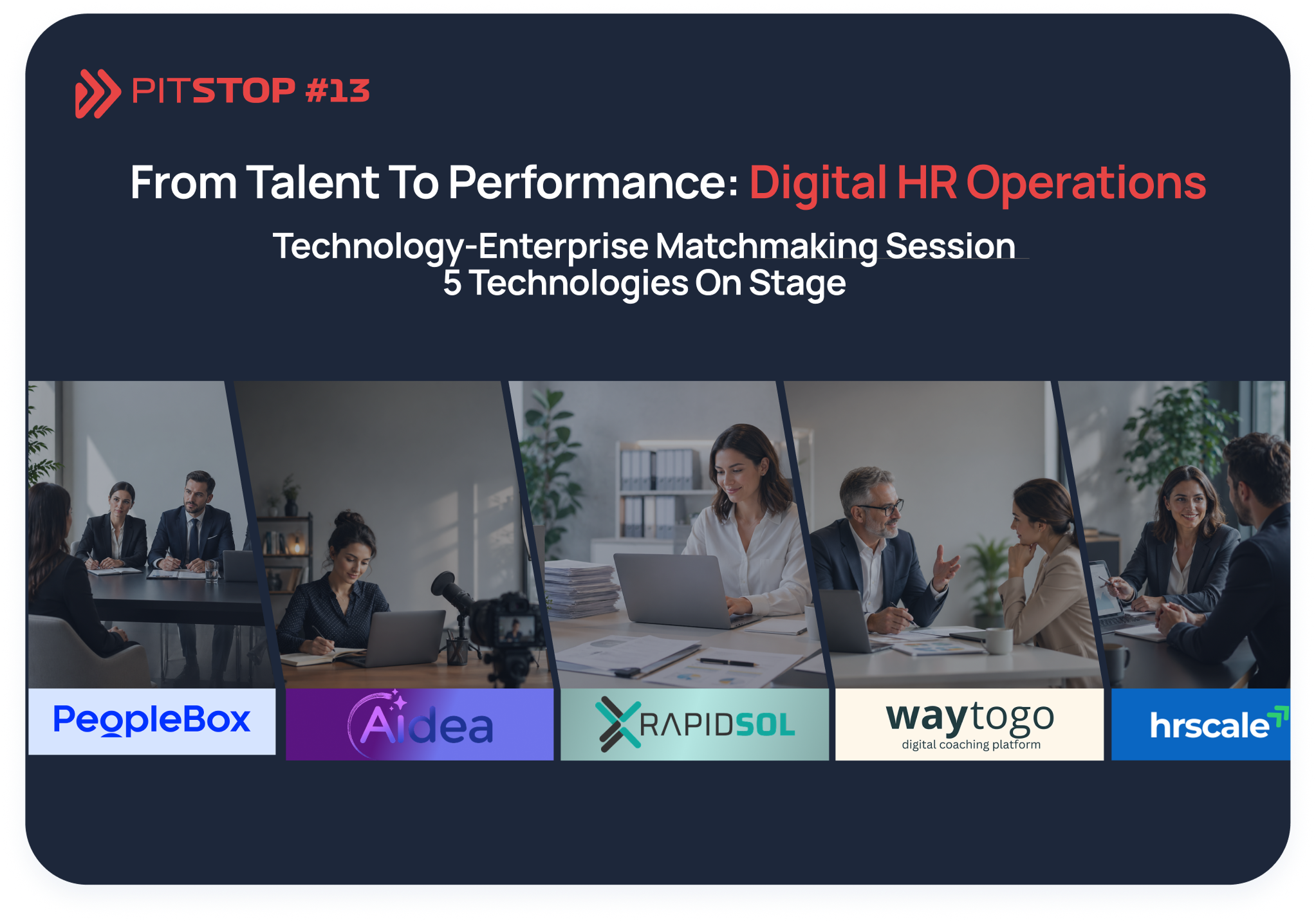
PitStop #13 - Tuesday, May 12
If you are a corporate company and want to see how this architecture is built through real customer cases, join PitStop #13, where 5 solutions selected from 42 technology companies will present.
 Pit Team
If you are a technology company and want to meet the right corporate customer at the right time, register to take part in our PitStop sessions:
👉 https://forms.office.com/r/hEVhE72L2Z
PitStop is a session series that brings technology companies and corporates together on the right theme at the right time. For each theme we meet one-on-one with more than 60 technology companies and select the best fit based on agenda, references, success stories and upcoming focus areas. The selected companies are chosen so that they do not compete with each other.
Previous PitStop Sessions and Content
 Pit Team
 Pit Team

 Pit Team
This post is part of our Industry Analysis section, where you can find more posts like it.


Discussion